


Most funding announcements don't earn coverage. They confirm a transaction, hit a wire service, and disappear within 24 hours. If that sounds like the last release your company sent out, you're not alone, and the fix is simpler than most teams expect. A strong PR funding strategy is what separates the rounds that generate top-tier coverage from the ones that get three wire pickups and nothing else.
It starts with understanding what a funding press release actually needs to do.
The dollar amount matters less than you think. Journalists covering B2B tech have seen every round size, and they're not looking for a number. They want a story: a specific market problem your company is solving, a credible investor thesis, traction data that makes the investment make sense, and a use of funds breakdown that tells them exactly where the money is going. That's when coverage actually happens.
This guide covers everything specific to funding announcements. When your round is actually worth announcing publicly, how to write a release that gives journalists what they need, how to reach the investors, partners, and press that matter at this stage.
When Should You Issue a Funding Announcement Press Release? (and when not to)
Issue a funding announcement press release when the round is legally closed, the figures are confirmed, and you have a story that goes beyond the number itself. If those three conditions aren't met yet, a direct investor update or a LinkedIn post will do more for you than a press release will.
Issue a funding announcement press release when:
- Everything is legally confirmed and closed. That means documents signed, funds transferred, and every investor name verified. Going out before any of those are locked creates legal exposure and damages investor relationships you will need down the line. Journalists who catch an error in a funding announcement tend to remember it. There is no upside to rushing.
- Your investors carry weight with the journalists you're targeting, and that matters more than the round size. A recognized VC or a strategic backer moves the headline from "company raises money" to "credible team backed by people who know this space." At Series A and beyond, investors researching you will expect to find coverage. A funded company with nothing published raises questions that are hard to answer in a pitch meeting.
- The round size is meaningful for your stage. For early-stage companies, $1 million or more is a reasonable starting point. For later rounds, the number needs to hold up against what your sector considers significant and what you have announced before. If the figure wouldn't register with the journalists covering your market, you need a stronger narrative to carry it.
- You have a specific plan for the capital. A named product milestone, a market expansion, a hiring target, a regulatory goal. Something that tells journalists exactly what this money enables. Without that detail, a funding announcement is just a number. With it, you have a narrative, and narratives are what get covered.
- You're introducing your company to the market for the first time. A stealth launch gives you something rare: the chance to define your own story with no prior coverage to work against. Pairing it with a funding announcement gives you credibility, visibility, and narrative control in a single document. That combination doesn't come around a second time.
- Your funding announcement does more than one job at once. Customers want to know you're stable. Candidates want to see you're growing. Future investors want proof you can operate publicly. And your own team should hear it from you before they read it somewhere else. Very few announcement types reach all of those audiences in a single move.
Skip the press release when:
- It's a bridge round. Bridge financing is short-term runway capital, and journalists covering venture know exactly what it signals. Most won't cover it. The ones who do will write the story on their own terms, and that framing rarely works in your favor. This belongs in a direct investor update, not a public announcement.
- Your investors have asked for confidentiality. Some deals come with no-public-announcement clauses, and breaking one creates problems that dwarf any coverage opportunity you might have gained. Check disclosure permissions with your legal team and lead investor before anything goes near a journalist. The relationship you protect here is worth more than the announcement you're sitting on.
- The story is too thin to hold up. A modest pre-seed round with no investors your space recognizes, with no clear direction for the capital, won't generate meaningful coverage. What it will do is set a low benchmark that makes your next announcement harder to land. Every release you send builds how journalists see the ones that follow.
- The details are still being confirmed. Unverified figures, incomplete investor names, terms still under discussion. None of it belongs in a press release, which is a public financial disclosure whether you think of it that way or not. Publishing inaccurate details and correcting them later creates a second story that's harder to manage than the first, and the credibility damage outlasts both.
- You're already in conversations for your next round. Announcing one raise while actively closing another makes your timeline visible in ways that invite questions. Investors and journalists who cover the space will notice how quickly the next round follows, and a compressed timeline between announcements suggests pressure you would rather not have visible in a pitch meeting.
Before you draft anything, ask yourself one honest question: would a reporter at your top three target publications find this genuinely interesting, or would covering it be doing you a favor? If the answer is a favor, it belongs in your investor update, your newsletter, or a LinkedIn post. Not in a press release.
What to Include in a Funding Announcement Press Release
A funding announcement press release should include these elements in order: release label, headline, subheadline, dateline, lead paragraph, company context, traction data, use of funds, founder quote, investor quote, boilerplate, and media contact. Every element has a job, and the reporters, investors, and analysts reading it already know what to expect from each one.
- Release label. For funding announcements, this almost always means "FOR IMMEDIATE RELEASE." The window for funding news is short. An embargo works when you're coordinating across multiple outlets or with a co-announcing investor, but get written confirmation from every party before a single detail leaves your hands.
- Headline. Four things belong here: who raised, how much, which round stage, and what the capital enables. Use an active verb. Use the exact round designation from your term sheet. Drop "proud to announce" before it reaches the draft. A headline that answers what this money makes possible gives journalists a story. One that only confirms a transaction gives them a number.
- Subheadline. One line for what the headline couldn't hold: the lead investor's name, a traction metric, a total funding figure, or a market signal. "Round led by Sequoia Capital brings total funding to $32M as company expands into APAC" gives a journalist a reason to keep reading before they've hit the lead paragraph.
- Dateline. AP style: city in all caps, state abbreviation where needed, full date before your opening sentence. Use your headquarters city. Small formatting errors signal a careless release before anyone has read a word of the actual announcement.
- Lead Paragraph. Two to three sentences, six questions answered: who raised, what round, when it closed, where the company operates, why it matters, and how the capital will be deployed. Name the lead investor and include one credential that tells journalists why their backing carries weight. This paragraph should be able to stand completely on its own.
- Company Context. Most companies skip straight to the money. Most journalists need the context first. This paragraph answers one question: why does this company matter enough for serious investors to back it? Cover what you do, who you serve, what traction you have built, and why the market opportunity is real. A journalist covering your company for the first time has no frame of reference for why the funding is worth a story without it.
- Traction data. Numbers are what turn an announcement into something journalists can actually build from. Year-over-year revenue growth, enterprise customer count, retention figures, geographic milestones, cumulative funding total. A concrete performance signal gives reporters something to anchor their opening on, and a named enterprise customer makes it stronger.
- Use of funds. This is the paragraph that earns coverage. Specific, concrete deployment plans: headcount targets, regulatory milestones, market expansion timelines. Vague language about "accelerating growth" tells journalists nothing. Specific plans give them something to quote, investors something to evaluate, and buyers something to act on.
- Founder quote. A named senior leader, full title, nothing that repeats the body copy. The best founder quotes express genuine conviction about the market and what this capital specifically changes. If it sounds like it came from a brand document rather than someone who spent years building the company, rewrite it.
- Investor quote. The only part of the release where someone other than you explains why the round happened. A named partner at the lead firm validating the investment thesis carries more weight than anything else in the document. A second quote from a co-investor only earns its place if it adds a genuinely different perspective. Two quotes saying variations of "we believe in this team" waste the space.
- Boilerplate. Two to three sentences: what you do, who you serve, where you operate, your website. If your lead investor isn't widely known in your target market, add a short second boilerplate explaining who they are. Don't make journalists research your backers themselves.
- Media Contact. One person, one email, one direct phone number. No shared inboxes. A journalist on deadline needs one clear path to a real person who can answer questions, pull additional data, and arrange founder or investor interviews fast.
Learn more about the standard press release format
How to Write a Funding Announcement Press Release
To write a funding announcement press release, start with the outcome the capital enables, not the amount raised. Build a lead paragraph journalists can quote without reading the rest. Back the investment with traction data, name exactly where the money is going, and write quotes that add conviction rather than restate the facts. The structure is consistent across every round stage. What changes is how much evidence you have to work with.
Step 1: Write the Headline Around the Outcome, Not the Amount
The round stage and dollar figure belong in your headline, but they should never lead it. "Company X Raises $15M Series A" confirms a transaction and gives journalists nothing to build a story from. It answers the what without touching the why. The reporters covering your space receive dozens of funding headlines every week in exactly that format, and most get filed without a second look.
Anchor the capital to something specific instead: a named market, a product milestone, a customer problem the round is directly funded to solve. "Company X Raises $15M to Bring Automated Tax Compliance to Mid-Market SaaS Companies" contains the same facts but now has a direction, an audience, and a problem worth covering. Same round. Completely different story.
A few rules that hold across every funding headline: use the exact round designation from your term sheet, Series A, Series B, Seed, not approximations like "early-stage funding" or "growth capital." Keep it under 12 words where possible. The only time the figure should lead is when the number itself is genuinely the news, such as the largest Seed round ever closed in your sector. Every other time, the outcome leads and the amount follows.
Step 2: Write a Lead That Works Without the Rest of the Release
Your lead paragraph needs to work completely on its own. A reporter should be able to pull two or three sentences from it and file a brief without reading anything else. That means the company name, the exact round designation and amount from the term sheet, the closing date, the lead investor with one line establishing their relevance, and a specific use-of-funds signal all need to be in there before the paragraph ends.
The closing date is not interchangeable with the release date. Investors, analysts, and journalists covering your space will check both, and a discrepancy between what your release says and what appears in public filings creates a credibility problem before anyone has read past the opening. A name alone is not enough for the investor either. One line of context, a notable portfolio company, a sector focus, a fund size, tells journalists what the backing actually signals without sending them to search for it themselves.
Leads that make reporters work to find the amount, the stage, or the investor name get passed over. Those are the three facts that determine whether the round is worth covering, and they belong in the first two sentences.
Step 3: Build the Company Narrative in the Body
Once the lead establishes what was raised, the body needs to explain why it was raised. Not your vision or your market thesis, but the specific facts that made a credible investor decide this company was worth backing at this stage.
Start with what you do and who you serve, plainly enough that a journalist without deep sector knowledge can place you immediately. Not "the leading platform for modern teams." The problem you solve, the customer who has it, and the environment they operate in.
Then sequence the evidence in order of weight. Year-over-year revenue growth first, then enterprise customer count, net revenue retention, and named customer wins that carry recognition in your category. Close with the market context that makes the timing significant: a regulatory deadline creating demand, an infrastructure shift opening a gap, or a category dynamic that positions your company ahead of where buyers are moving.
Phrases like "transforming how companies work" or "reimagining the future of" signal that the evidence doesn't exist yet. A specific growth rate or a named customer tells journalists everything those phrases never could.
Step 4: Write Quotes That Add Perspective, Not a Summary
Quotes are the most misused element in funding releases. Most restate facts already in the body, which wastes the one section journalists are most likely to lift and publish directly. A good quote doesn't summarize what already happened. It adds conviction, context, or a point of view that only this specific person can credibly make.
For the founder or CEO quote, two things matter: what this capital specifically changes about the company's trajectory, and how that connects to the market problem the company was built to solve. Write it in the voice of someone who has spent years on this problem.
If the quote could belong to any founder at any company, rewrite it. "We are thrilled to partner with investors who share our vision" belongs to everyone. "This round lets us move from proving the model in the US market to building the infrastructure that makes enterprise compliance automatic across every jurisdiction we enter" belongs to one company.
For the investor quote, a named partner at the lead firm should speak to the specific thesis behind the investment and reference something verifiable that goes beyond "we believe in this team." If the lead investor hasn't supplied a quote yet, request one directly from the named partner before the release goes out. Most will provide one. Aim for two quotes total. Three is the ceiling, and only if each adds a genuinely different angle.
Step 5: Specify Where the Capital Is Going
"To accelerate growth" is not a use-of-funds statement. Neither is "to scale operations" or "to expand our platform." These phrases appear in hundreds of funding releases every month and tell readers nothing about the actual deployment plan. Journalists cannot quote them. Future investors cannot evaluate them. Enterprise buyers learn nothing from them during vendor due diligence.
Name at least two specific destinations for the capital:
- Headcount targets by function and geography: "to hire 40 engineers across its Berlin and Singapore offices by Q3"
- Product milestones with a timeline: "to complete SOC 2 Type II certification and launch its enterprise tier by Q4"
- Market expansion with named geographies: "to enter the UK and Dutch markets and establish a local sales presence in each"
- Regulatory or certification milestones: "to complete FDA 510(k) clearance for its diagnostic platform"
- Infrastructure investment with a measurable outcome: "to migrate its core platform to a multi-region cloud architecture supporting 99.99% uptime SLAs"
Specific use-of-funds language signals to everyone reading that the team has thought through what comes after the close. That signal carries weight with every audience that matters after launch day.
Step 6: Back the Round With Data Journalists Can Actually Use
Investor confidence is not a story on its own. Without at least two concrete data points, you're asking reporters to take the round at face value. Most won't.
The data that does the most work:
- ARR or revenue growth as a percentage or multiple. "Grew ARR 3x year-over-year" is a signal qualitative language cannot replicate.
- Enterprise customer count with a named reference where possible. "Now serves 120 enterprise customers including two Fortune 500 financial services firms" carries weight that "a growing enterprise customer base" does not.
- Net revenue retention above 100%, which tells investors and analysts that existing customers are expanding, not just renewing. That's a different signal and worth stating explicitly.
- Expansion milestones since the last round such as geographies entered, verticals added, partnerships closed. These place the current raise in the context of a trajectory rather than presenting it as a standalone event.
- Product adoption metrics tied to a specific timeframe. "Processed over 2 million transactions in the 90 days following its Series A" is bounded, specific, and gives journalists a concrete performance signal to anchor coverage on.
If two of these aren't available, reconsider the timing. A funding announcement built on potential rather than performance is harder to place, and a harder standard to recover from if the next round arrives before the metrics catch up.
Step 7: Close With a Boilerplate That's Current and a Contact Who Answers
The boilerplate is where journalists, analysts, and investors go first when they want context on your company. If it hasn't been updated since your last round, update it before this one goes out. Outdated headcounts and old product descriptions signal a team not paying attention, and that impression lands before anyone reads the announcement itself.
The media contact block has higher stakes than most companies expect. One name, one direct email, one phone number that gets answered on announcement day. A reporter on deadline who can't reach someone within the hour won't follow up twice. They'll file without your comment or move to a story that's easier to report. Name a backup contact if there's any chance your primary will be unavailable. One clear path to a real person, no friction.
How to Distribute and Promote a Funding Announcement Press Release
Publishing the press release is not enough on its own. You need a coordinated strategy that puts the announcement in front of the right people before the news cycle moves on: an exclusive or embargo decision made, wire distribution, direct pitches, owned channels that give the announcement a permanent home, and your investor and partner networks to extend the story well past day one.
Make the Exclusive vs Embargo Decision First
An exclusive means one journalist at one outlet gets the story before anyone else. TechCrunch, Fortune, The Information, Forbes, and sector publications like Axios Pro Rata or PitchBook News are the natural targets depending on your round size and industry. A journalist with an exclusive has a real reason to invest time in a longer, more researched story rather than a reactive brief. The risk is equally straightforward: if they pass, you lose the time it took to find out.
An exclusive works when the round, the investor name, or the founder story is strong enough to anchor a feature on its own. A $50M Series B led by a recognizable firm with a narrative worth telling clears that bar.
A wide embargo means pre-pitching multiple journalists under a written timing agreement. They hold the story until a set date and time, giving you coordinated coverage across several outlets on announcement day. When pitching under embargo, the rule is consistent: do not share the amount, investor names, or valuation until each journalist confirms the terms in writing. Once confirmed, send the full release, offer interview access to the founder and lead investor, and follow up before the lift to confirm they have everything they need.
Learn more about embargoed press release
Use a Newswire Strategically, Not as a Default
A wire service reaches the audiences direct outreach alone cannot: business and financial press monitoring wire feeds daily, financial terminals tracking company activity, and news aggregators indexing your announcement for investors and analysts searching your name or category.
Press release submission websites such as PR Newswire and Business Wire are the standard choices for venture-backed companies. GlobeNewswire is worth adding if AI search visibility is a priority.
Costs typically run between $400 and $1,000 or more depending on word count and geographic targeting. For early-stage companies with modest rounds, wire distribution is optional if your direct outreach is already generating real coverage. For later-stage rounds where institutional investors, enterprise buyers, and financial analysts are in your target audience, skipping it means your announcement simply does not exist for the people using wire feeds as a standard research tool.
The wire gets you indexed. It does not get you covered. Pair it with direct journalist outreach, social activation, and owned media publishing, or most of the announcement's potential goes unused.
Build a Targeted Journalist List, Not a Broad One
Most meaningful funding coverage comes from a short list of journalists who already cover your space, your stage, or your lead investor's portfolio. Before the announcement date, build a curated list of 10 to 20 reporters. For each one, look at their last ten bylines and identify what they have actually been writing about recently.
Connect your announcement to that angle directly in the pitch. Reference something specific they wrote and frame your round as the next development in that story. Then give them something to work with: founder access, time with the lead investor, a customer reference who can speak on record, or early data that adds depth beyond what is in the release.
Make sure your founder, CEO, and investor contacts are available and responsive on announcement day. A journalist who reaches out for comment and hears nothing before their deadline will file without your input or won't file at all.
Learn more about media pitching
Activate Owned and Shared Channels at the Embargo Lift
Your newsroom page is the permanent, searchable record of the announcement and the URL every other channel points back to. Journalists verifying details, investors doing background research, and analysts tracking your category will all look there first. Everything below should go live the moment the embargo lifts.
- A founder LinkedIn post written in first person that tells the story behind the round. Why this investor, why this moment, and what this capital makes possible. Keep it completely separate from the press release language.
- A company LinkedIn post leading with your strongest traction data point and linking directly to the full release.
- A customer and partner email framed around what the funding means for them specifically: what gets built faster, what expands into new markets, what improves in the product they already use.
- An internal communication to employees that connects the milestone to the work that earned it, sent before the release goes public.
- Pre-written social copy for board members, investors, and key employees willing to share. Draft it, format it for LinkedIn and X, and send it ready to post without editing. The easier you make amplification, the more likely it happens on day one when coverage is live and attention is highest.
Learn more about owned and shared media
Use Your Investor Network as a Distribution Asset
Your lead investor is one of the most underused assets available to you on announcement day. Established VC firms run their own communications channels: LP newsletters, LinkedIn pages with large followings, and long-standing relationships with the exact journalists you are pitching. Reach out to your investor's communications team well before the lift date to confirm they are co-announcing from their side.
Agree on channel sequencing, align on the exact figures both parties will use, and send them ready-to-use social copy. Most founders forget this conversation until it is too late.
A co-announcement from the lead firm puts your round in front of LP networks, co-investor communities, and media contacts the firm has cultivated across years of portfolio deals. If a strategic partner or anchor customer is part of the story, explore whether they can provide a named quote or supporting statement that goes out alongside the release. One external voice from a recognizable organization does more credibility work than anything you can say about yourself.
Learn more how to send a press release
Real-Life Funding Announcement Press Release Examples
Funding announcements look different depending on the round size, the market, and the story the company is trying to tell. The three examples below show what happens when a funding press release is built around the story behind the round, not just the round itself.
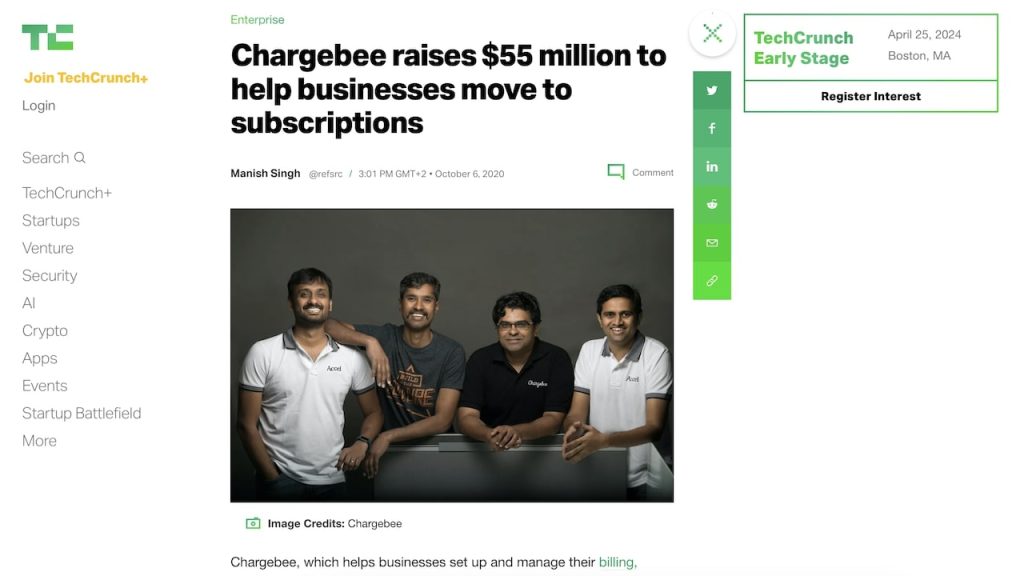
Chargebee
Chargebee's Series F press release worked because it didn't try to be one thing for every market. The release was built around geographically relevant angles: US journalists got the growth and scale narrative, Dutch and German outlets got a European fintech story with local context. Same round, same facts, but the use-of-funds section and market framing were specific enough that each journalist had a different reason to cover it.
Most funding releases are written for a generic reader. Chargebee's was written for a specific journalist in a specific market. That's the structural difference. The result was over 50 simultaneous placements including TechCrunch, Reuters, CNBC, and Bloomberg, reaching a combined readership of 128 million.
Read the full Chargebee case study
Wayflyer
When Wayflyer closed their €150M Series B at a €1.6B valuation, the press release didn't open with the unicorn milestone. It opened with the problem: e-commerce businesses struggling to bridge cash flow between inventory cycles. The valuation appeared, but it was framed as the outcome of solving that problem at scale, not as the headline itself.
The release also included traction data that gave journalists something to verify independently, a named lead investor with a clear thesis, and a use-of-funds section specific enough to tell readers what the capital would actually change. Those elements together gave reporters across venture, fintech, and e-commerce beats a reason to cover it from their own angle.

Read the full Wayflyer case study
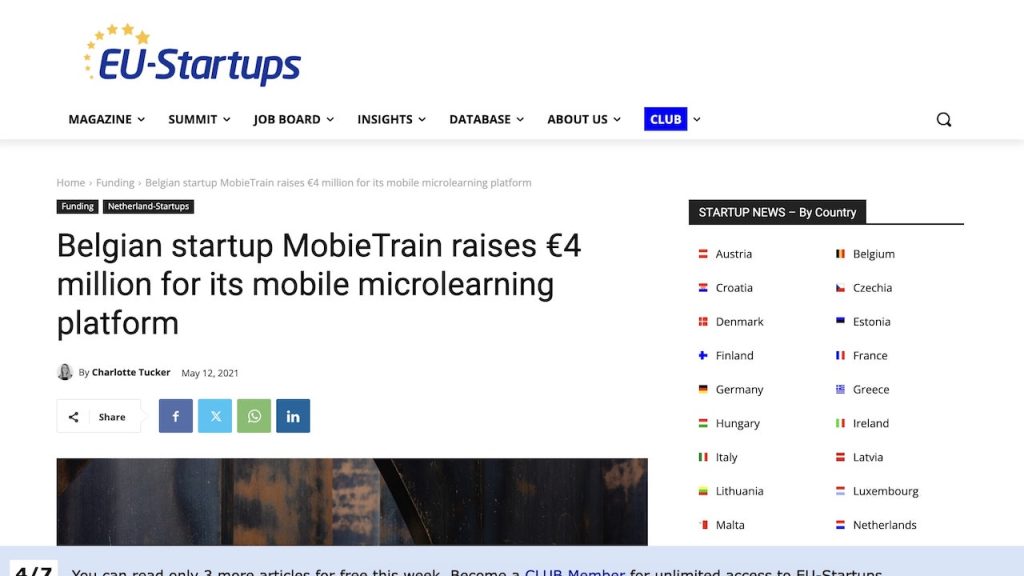
MobieTrain
MobieTrain's €4 million Series A press release had one job beyond announcing the round: establishing the company as a credible international player at a stage where most EdTech companies are still purely regional. The release did that by leading with the lead investor, following immediately with the names of contributing investors, and then connecting the capital directly to a named international expansion plan.
The use-of-funds section was specific enough to tell journalists exactly where the company was heading and why the timing made sense. For a company entering markets where it had no prior brand recognition, that combination of investor credibility, specific deployment plan, and funding trajectory gave the release far more weight than the round size alone would have carried.
Read the full MobieTrain case study
Best Practices
Most funding announcements underperform not because the round was unimpressive, but because the release did not do its job. These best practices are what the announcements that consistently earn top-tier coverage and build lasting credibility get right.
- Coordinate with your investor's communications team at least two weeks before the lift date, not the day before. A VC firm co-announcing from their own channels puts your round in front of LP networks, portfolio communities, and media relationships the firm has built over years. Confirm the lift time in writing. That single step prevents the most common and most damaging distribution mistake founders make.
- Segment your outreach by journalist beat, not by outlet tier. A release sent to TechCrunch, Fortune, and your sector trade publication in the same pitch misses the point. Each journalist covers a different angle: venture funding, enterprise software, fintech infrastructure. Write a different pitch for each beat and connect your round to the specific story that the journalist has been following. Same release, three different reasons to cover it.
- Brief your product and customer success teams before anything goes public. Enterprise buyers and existing customers will read your funding announcement before your sales team has a chance to follow up. If the release references a product expansion or a new market and your customer success team doesn't know about it yet, you create confusion at exactly the moment you need confidence. Brief internal teams before the release goes public, not after.
- Treat the announcement as the opening of a content window, not a single event. The 48 hours after a funding release goes live are when journalist interest, investor attention, and buyer awareness peak at the same time. Have a follow-up plan ready: a founder byline at a target publication, a customer story tied to your use-of-funds narrative, a data-led post from the lead investor.
- Match the release length to the round stage. A seed announcement running 800 words signals a team that doesn't understand what the news warrants. A Series C with two sentences of traction data signals a team that doesn't understand what investors need to see. Early-stage releases should be tight and narrative-led. Later-stage releases should be evidence-heavy enough to satisfy institutional readers doing due diligence.
- If your lead investor isn't widely recognized in your target market, explain them. Don't assume every journalist covering your space knows every firm. One sentence establishing fund size, a notable portfolio company, or a sector focus tells readers what the backing actually signals without sending them to search for it themselves.
- Get legal sign-off on every figure before distribution. Funding announcements are public financial disclosures. An incorrect round size, a misattributed investor name, or a valuation figure that contradicts public filings creates a correction story that follows you into the next raise. Every number needs to be verified against the term sheet and cleared by legal before a single journalist sees it.
Common Mistakes to Avoid
Even well-resourced communications teams make avoidable errors on funding announcements. Most fall into three categories: writing that buries the news, claims that invite skepticism, and distribution decisions that limit reach. Here's what each one looks like in practice.
- Don't dress up a bridge round as a strategic capital. Journalists and investors who cover ventures know exactly what a bridge round looks like from the structure and the investor composition. Growth narrative language doesn't change what it is. What it does is create a credibility problem that follows you into your next real announcement, when the reporters you actually need will already have a reason to be skeptical.
- Don't put unconfirmed figures in the release. Uncommitted capital, unconverted notes, amounts not yet verified by every investor. None of it belongs in a press release. Journalists will cross-reference your numbers against public databases within hours. A correction doesn't just fix a number. It tells everyone reading that your communications can't be trusted, and that impression outlasts the original mistake.
- Don't treat a verbal embargo as binding. The moment round size, investor names, or valuation land in a journalist's inbox without written confirmation, they're free to publish. Get explicit written agreement on the date and time before anything sensitive leaves your hands.
- Don't announce too close to your next round. If you're already in late-stage conversations for the next raise, think carefully about timing. A compressed gap between announcements makes your fundraising cadence visible in ways that invite questions you don't want in a pitch meeting. Distance reads as confidence. A quick turnaround reads as pressure.
- Don't forget your own team is reading this too. Your sales reps, customer success managers, and employees will get questions from clients and partners within hours of the release going live. If they find out about the funding the same way the public does, they'll either say nothing useful or say something that contradicts your messaging. Brief them before anything goes out.
- Don't treat wire distribution as your media strategy. Founders who send the release to a wire service and wait are consistently disappointed. The wire puts your announcement in front of aggregators and financial terminals. It does not put it in front of the journalist who covers your space and has a reason to write about you. Those two outcomes require completely different actions.
Special Considerations for B2B Tech Companies
When doing PR for tech companies or startups, a funding announcement in B2B tech reaches a wider audience than most founders plan for. Journalists are only part of it. Procurement leads, IT buyers, legal teams, and C-suite contacts evaluating vendor stability are all reading the same release and asking different questions. Here's what to get right for each of them.
- Time the announcement around your sales cycle, not just the news cycle. Before you confirm the date, talk to your sales and customer success teams. They know which accounts are in active evaluation and which prospects have been waiting for a financial stability signal before they commit. A release timed to budget planning season or a contract renewal window pulls in inbound that media timing alone won't.
- Name the category you compete in. Buyers build RFPs around categories. Analysts structure market reports using them. Journalists route stories through them. If your release doesn't anchor you in one, the story gets harder to place and harder to act on. If you're defining a new category rather than competing in an existing one, explain exactly what it replaces and why that matters to the person signing the purchase order.
- Let your lead investor do credibility work for you. In B2B tech, who led the round carries as much weight as the number. If the partner has backed companies in adjacent verticals, name that pattern explicitly. Enterprise procurement teams use investor composition as part of vendor due diligence, and the right name does work your own language never can.
- If the round funds compliance infrastructure, say so upfront. Buyers in regulated industries read your use-of-funds section looking for one answer: does this capital make you more or less likely to meet their obligations? SOC 2 Type II, FedRAMP, HIPAA, ISO 27001. For a procurement lead comparing vendors, that line might be the most important one in the release.
- Tie at least one use-of-funds item to something your customers actually care about. A section built entirely around headcount and sales infrastructure sends one message: this money is going into your growth, not theirs. Give them something concrete instead. Faster implementation timelines, a long-requested integration, a capability tied to a product commitment you've already made publicly.
- Write something analysts can use. Gartner, Forrester, and IDC analysts track funding rounds as part of their market coverage. Give them verifiable data, clear category positioning, and use-of-funds items tied to specific product commitments, and they have something they can incorporate directly into their reporting. Getting into an analyst market report builds more credibility with enterprise buyers than media coverage alone.
Template
Use this template once you can confirm four things: the round is legally closed, all figures are verified by every participating investor, the lead investor has confirmed the lift time in writing, and your internal teams are briefed. If any of those conditions aren't met yet, hold the release until they are.
FOR IMMEDIATE RELEASE
[Company Name] Raises [Amount] [Round Stage] to [Specific Business Outcome in 8 Words or Fewer]
The outcome leads. The amount follows. Your headline should tell a journalist what this capital makes possible, not just confirm that a transaction happened.
Strong examples: "[Company] Closes $25M Series B to Expand Real-Time Payment Infrastructure Across APAC" "[Company] Raises $10M Seed to Automate Compliance Reporting for Mid-Market Banks" "[Company] Secures $50M Series C to Accelerate AI-Driven Fraud Detection for Enterprise Insurers"
Avoid: "[Company] Announces Exciting New Funding Round" "[Company] Raises $XM to Continue Its Growth Journey" Any headline using "proud," "thrilled," "game-changing," or "revolutionary"
[Optional Subheadline]
One sentence. Use it for what the headline couldn't hold: the lead investor's name, a traction metric, a total funding figure, or a market signal. Under 20 words.
Example: "Round led by [Investor Name] brings total funding to $[X]M as company expands into [named market or vertical]."
[CITY, Country] — [Month Day, Year]
[Company Name], [one-line descriptor of what you do and who you serve], today announced the close of a [round stage] funding round of [exact amount from term sheet], led by [lead investor name], [one credential establishing why this investor's backing matters in this specific market]. The round also included participation from [co-investor names]. The capital will be used to [specific use 1], [specific use 2], and [specific use 3 with named geography, function, or timeline].
Company Context and Market Opportunity
[Company Name] [what the product does and who it serves, plainly enough that a journalist without sector knowledge can follow it immediately]. [One to two sentences on the specific market problem and why existing approaches haven't solved it]. [Market sizing with a named source: "the global [category] market is projected to reach $[X]B by [year], according to [source]"]. [One to two sentences on traction already built before this round closed: ARR growth as a multiple or percentage over a defined period, enterprise customer count, net revenue retention, or a named customer reference with a specific outcome].
Use of Funds
The [round stage] funding will be deployed across [two to three named areas]. [First: specific headcount target by function and geography with a timeline, for example "to hire 40 engineers across its London and Singapore offices by Q3 [year]"]. [Second: named product milestone, certification, or regulatory clearance with a completion target, for example "to complete SOC 2 Type II certification and launch its enterprise tier by Q4 [year]"]. [Third: named market expansion with a launch date or geographic scope, for example "to enter the UK and Dutch markets and establish a local sales presence in each by [year]"]. [Include at least one item tied directly to a customer outcome: faster implementation timelines, an expanded integration, or a specific capability already on the product roadmap].
Quote 1 — Founder or CEO
"[Quote expressing specific conviction about the market and what this capital changes about the company's trajectory. Connect the funding to the problem the company was built to solve. Write it in the voice of someone who built the company, not a brand document. No restatement of the round figures. Nothing that opens with 'We are thrilled' or 'We are excited.' If this quote could belong to any founder at any company, rewrite it.]" — [Full Name], [Exact Title], [Company Name]
Use one of these structures as a starting point: "This round lets us move from [where we are] to [where we're going], specifically because [what the capital enables that wasn't possible before]." "We built [Company] to solve [specific problem]. This capital means [concrete next step], and it means [what that delivers for customers]."
Avoid: "We are thrilled to welcome this investment" "We are excited to partner with investors who share our vision" Any quote that could appear in a competitor's release with the name swapped
Quote 2 — Lead Investor
"[Quote from a named partner at the lead firm explaining the conviction behind the investment. Name the specific thesis: what the firm saw in the team, the market, or the technology. Reference something verifiable: a traction signal, a market dynamic, a customer problem reaching scale. Do not repeat what the founder quote already said. Do not use 'we believe in this team' without something behind it.]" — [Full Name], [Exact Title], [Investor Firm Name]
Quote 3 — Co-Investor, Board Member, or Named Customer
Include only if this quote adds a perspective the first two cannot: a customer articulating a specific operational outcome, a co-investor with domain expertise in a vertical the lead investor doesn't cover, or a board member connecting the product direction to a market shift they've seen firsthand. If it says a variation of what the previous two quotes already said, cut it.
"[Quote that adds a genuinely different angle: a customer describing a real outcome, a co-investor explaining why this vertical is ready now, or a board member connecting the company's roadmap to a market shift already underway.]" — [Full Name], [Exact Title], [Organization Name]
Traction Data
[Company Name] has [specific traction metric 1: ARR growth expressed as a multiple or percentage over a defined period, for example "grown ARR 3x year-over-year"]. The company now serves [customer count] [customer segment] customers across [geographic scope], including [named reference if permitted]. [Optional: net revenue retention figure, a named partnership, or a product adoption milestone tied to a specific release or timeframe]. This round brings the company's total funding to [cumulative amount across all rounds] since its founding in [year].
ABOUT [COMPANY NAME]
Example: "[Company] is a [what you do] for [who you serve]. Over [number] [customers/teams] across [regions] use [Company] to [outcome in plain language]. Founded in [year] and [SOC 2 Type II certified / HIPAA compliant / FCA regulated], the company focuses on [two to three focus areas in plain language]."
ABOUT [LEAD INVESTOR FIRM NAME]
Include this if your lead investor isn't widely recognized in your target media market. One to two sentences: what the firm invests in, stage focus, notable portfolio companies, website URL. Don't make journalists research your backers themselves.
MEDIA CONTACT: [Full Name] [Exact Title] [Direct Email Address] [Direct Phone Number — must be answered on announcement day] [Company Website] [Press Kit or Newsroom Link — no login, no form, direct download]
NOTE TO EDITORS: For founder interviews, investor briefings, or customer references available to speak on record, contact [Name] at [email] or [phone]. After-hours availability on announcement day: [yes / no and contact method].
Conclusion
Getting a funding announcement right isn't about round size or investor name recognition. It comes down to a specific narrative, verified figures, quotes that give journalists something worth printing, and a distribution plan that puts the right story in front of the right people on the day it matters. That's achievable at every stage, from a $2M seed to a $100M Series C, as long as the release is treated as an editorial decision rather than an administrative one.
A funding announcement press release works best as part of a broader PR strategy where journalist relationships exist before you need them, your messaging is consistent across every channel, and the release itself is built around what your audience actually needs to read, not what your team wants to say.
Knowing which press release type fits which moment is part of that. A well-executed funding announcement doesn't just generate coverage on day one. It builds the public record that every future investor, enterprise buyer, and journalist will find when they start looking into your company.
FAQs
Who should be quoted in a funding announcement press release?
Two quotes are the standard: one from the founder or CEO, and one from a named partner at the lead investor firm. A third quote is warranted only if it adds a different angle, such as a co-investor with specific domain expertise, a named enterprise customer who can speak to product impact on the record, or a board member whose background adds credibility to the market thesis.
Is every funding round worth a press release?
No. Bridge rounds, small pre-seed rounds from unrecognizable investors, and rounds with confidentiality clauses are generally not worth announcing publicly. The signal a press release sends to the market is that this is significant enough to tell the world. If the round does not clear that bar in size, investor quality, or narrative strength, issuing a release can actually dilute your PR credibility for future, more meaningful announcements.
Do you need a wire service for a funding announcement?
It depends on your stage and your target audience. For early-stage companies where direct journalist relationships are generating real coverage, wire distribution is optional. For later-stage rounds where institutional investors, enterprise buyers, and financial analysts are in your target audience, skipping it means your announcement simply doesn't exist for the people using wire feeds as a standard research tool.
Can you reannounce a funding round that didn't get coverage the first time?
Not directly. Reissuing the same release weeks later with the same figures signals to journalists that the first attempt failed, and that context follows the story. What you can do is find a new news hook that happens to include the funding as supporting context: a major customer win, a product launch, a market expansion, or a significant hire.
What happens if a journalist breaks the embargo early?
Act immediately. Contact the journalist and their editor, reference the written embargo agreement, and request a retraction or a hold on publication. If the story is already live, notify every other journalist on your list that the embargo has broken and give them permission to publish immediately. Do not go dark and hope the coverage dies down.
Should your funding announcement mention previous rounds?
Yes, but briefly. Including your total cumulative funding figure gives journalists and investors a trajectory rather than a single data point. A Series B company that has now raised $47M total tells a more complete story than one announcing a $30M round with no prior context. Keep it to one line in the traction section. The current round is the news. Previous rounds are the evidence that this team has earned the right to raise again.


