


A recent GroupM report confirmed that global advertising spending surpassed $1 trillion in 2024 making an increase of 9.5% from last year. This significant investment shows how important both PR and Marketing are for brands looking to grow and stay relevant, however they take different approaches.
PR focuses on strengthening a brand's reputation and building trust with its key audiences like the media, investors, and the public while marketing acts on direct promotion—through ads, digital content, and offers. A strong strategy brings together marketing’s short-term results with PR’s long-term focus on trust and reputation. This combination can not only gain more customers for the brand but also promote lasting loyalty—helping brands build relationships that support long-term success.

Strengthen your brand with aligned PR & marketing strategies
PR vs. Marketing: what are they and why are they important?
What is PR?

PR is a practice focused on building the reputation of an organization and developing good relationships with key audiences such as the media, investors, and other stakeholders. Instead of marketing, PR uses press coverage, media interviews, thought leadership content, collaborations with influencers, and events to improve how people perceive a company or brand.
For example, if a new startup is mentioned in a well known media outlet for being innovative, then the PR exposure makes the startup more credible and attracts potential customers. In the case of a crisis, good PR can also help to save the image of the brand and protect their reputation.
Learn more about what is public relations
What is Marketing?
Marketing is a strategic practice of promoting a product or service to boost sales. Unlike PR, marketing directly targets consumer behavior and buying patterns using techniques like advertising, digital strategies, and pricing tactics. The goal is to build demand, drive top-line growth, and strengthen brand recognition.
For example, when a new smartphone is being launched, the marketing team may use social media advertising, email marketing and othertactics to increase sales. The success is measured by sales, return on investment (ROI) and business growth.
Why are PR and marketing important?
Both PR and marketing play a vital role in business success. A company investing only in marketing may struggle to build a strong reputation, while one focusing only on PR may lack the sales momentum needed to grow.
Marketing increases sales but PR develops the foundation of the company’s sustainability of such sales. By combining both a brand is not only visible but also credible and therefore a company will be able to attract customers, and stay competitive in the long run.
Differences between PR and marketing
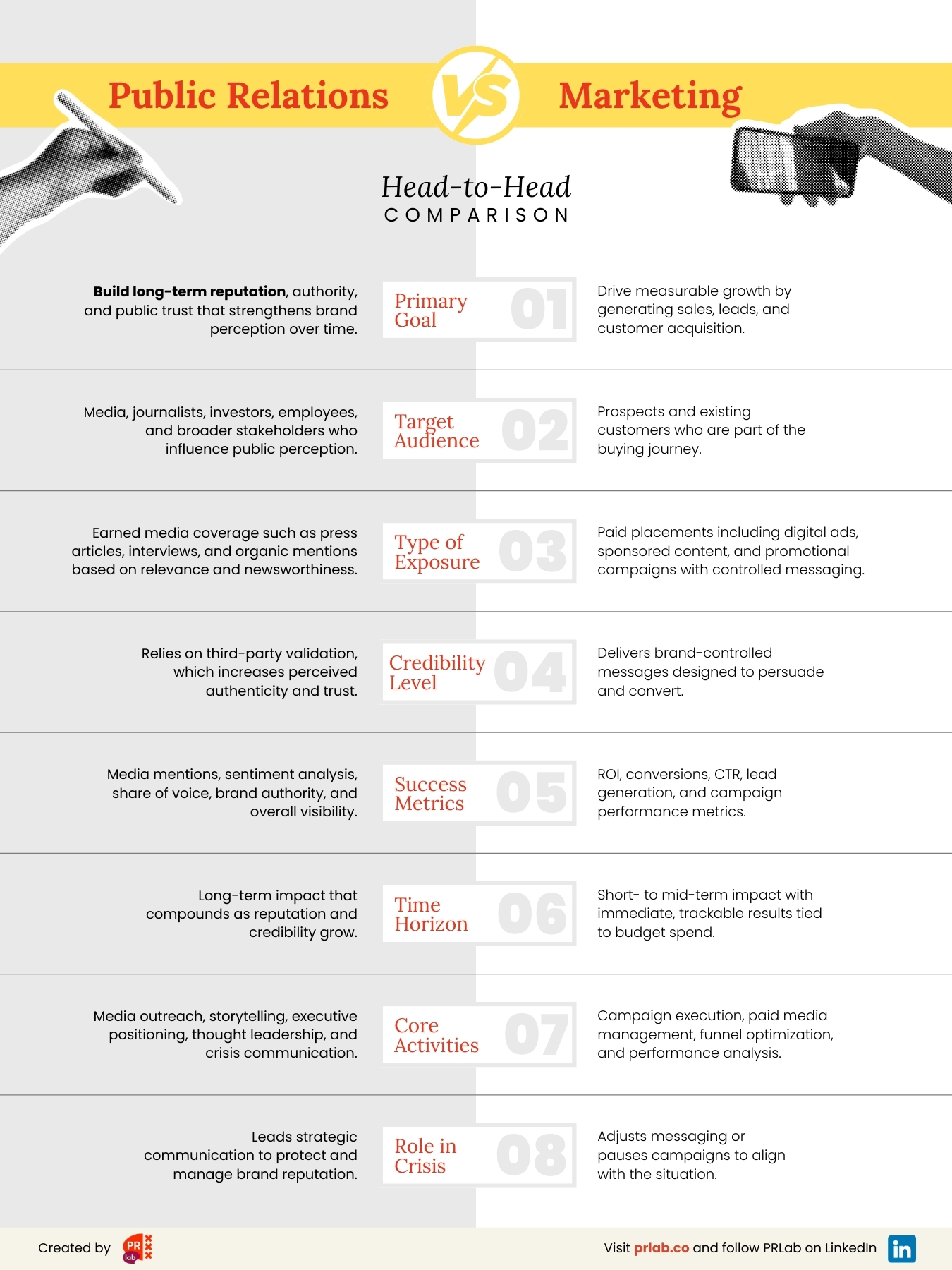
PR and marketing share the same goal—helping businesses grow—but they take different approaches. PR manages how the brand is perceived by its audiences and defends the brand's reputation, while marketing focuses on sales, using advertising, promotions, and content to attract and convert customers.
Nonetheless, it's important to recognize that PR does influence sales and lead generation, it contributes significantly, though in a more subtle manner.
The sections below will help you understand in depth those differences.
Purpose and goals
PR is all about reputation, it cultivates great relationships between a brand and its stakeholders like journalists, investors or influencers. PR focuses on reputation management, crisis communication, and long-term brand positioning. It increases credibility and trust in the long run, but often takes time to show results.
Marketing, on the other hand, focuses on results that can be measured. It consists of tactics like advertising, content marketing, email campaigns, and promotions, which drive sales through lead generation.
Unlike PR, marketing it’s easy to measure, with clear results like customer engagement, conversions, and revenue growth.
Everyday execution
Professionals working in PR focus on building strong messaging, establishing relations with the media, securing public speaking opportunities, promoting news and dealing with reputational risks or managing company messaging. They know how to craft the right story to create a positive brand perception and stay on top of the news and social trends so the company remains respected and visible.
Marketing teams, however, are involved in the implementation of campaigns, from creating designs, managing paid media, measuring KPIs, and optimizing them.
While marketing aims to drive traffic and sales, public relations is more about maintaining the brand’s image and public trust.
Media coverage: earned vs. paid
PR generates owned media—news articles, organic social media mentions, and influencer endorsements—without directly paying for exposure including channels the brand controls, like blogs or social posts. On the other hand, earned media comes from others talking about the brand because they find it relevant or newsworthy, not because they were paid to.
Through it, the brand receives third-party credibility as a benefit. A well-planned PR strategy can result in positive media coverage that can build trust and strengthen a brand’s credibility.
In contrast with PR, marketing relies on paid media, such as digital ads and sponsored posts. These tactics guarantee exposure to a target audience. Paid media ensures a guaranteed visibility, yet it might lack the same authenticity as earned media as consumers recognize that paid placements are designed to sell.
Learn about the PESO model® in PR
Audience approach
PR isn’t just about customers—it reaches the media, investors, employees, and the public. Through press coverage, thought leadership, and community involvement, PR helps brands earn trust and establish a strong industry presence.
Marketing, in contrast, is all about customer engagement that pushes potential buyers to take action by running targeted campaigns through social media, email, and influencer partnerships, marketing speaks directly to potential buyers to solve different pain points.
Measurement of success
PR success is about how people perceive a brand. It’s measured through media mentions, brand sentiment, and social engagement. Though PR but because PR influences trust rather than direct sales, its impact isn’t always easy to track with numbers. This is where PR metrics come in: website traffic, referrals, and click-through rates.
For instance, to go even deeper, brands also check PR KPIs, such as share of voice, message pull-through, media quality score, and audience reach—to better understand how earned media contributes to reputation and visibility.
Marketing, in contrast, is data-driven, Every campaign is evaluated through clear metrics like sales, leads, and ad performance. Marketing efforts can quickly measure its impact and adjust strategies in real-time.
Longevity and impact
PR is a long-term game, because its initiatives create credibility and trust over time. This means that businesses can’t expect immediate results right in the first few weeks. A positive mention or a successful PR strategy could reap great reputational benefits like customer trust, improving brand loyalty, and strengthening business credibility.
Marketing, on the other hand, tends to be relatively short-term and performance-driven. Long-term brand placement can sometimes fall under marketing strategy, but most campaigns are built for immediate results and frequently change based on performance metrics. Its effectiveness often depends on continuous investment and frequent adjustments.
Daily activities
PR teams focus on building and maintaining a brand’s reputation. Their daily work includes writing press releases, pitching stories to media outlets, and responding to journalist inquiries. They also oversee broader social media engagement, including LinkedIn PR, thought-leadership strategies and internal communication responsibilities to stakeholders such as employees.
Marketing teams are involved mainly in driving sales and engagement. This is where copywriting comes into play: websites, social media, and email marketing - and where advertisements and promotion materials are born. Understanding consumer behavior, measuring campaign results, and changing the strategy based on data analysis are some of the other activities under marketing.
They also collaborate with sales teams to align campaigns with business goals, ensuring that marketing investments generate a strong return.
The similarities between PR and marketing
PR and marketing share a common objective: establishing boosting brand visibility and driving business success. PR and marketing may serve different functions, but they both use communication, engagement, and storytelling to connect with audiences to influence public opinion. Here are other ways they overlap in their day-to-day work.
Brand building and awareness
Both PR and marketing play a key role in increasing a brand’s visibility and reputation. However, they do so in different ways. Marketing does it through paid campaigns to take a message to the right audience at the right time, while PR relies on media coverage and public trust based on credibility.
A strong brand balances both: PR builds credibility, while marketing expands reach. PR focuses on reputation building through long-term relationships and storytelling, while marketing amplifies the brand presence with targeted ad strategies.
When they work side by side, the brand becomes more consistent, reliable, and easier to recognize in the market.
Storytelling and content creation
The use of storytelling is a key component in both PR and marketing strategies: good stories make brands memorable. PR teams write content that earns attention—like press releases, articles and media pitching. Marketing teams design content for blogs, social media, and campaigns. When these efforts are aligned, the brand sounds clear and consistent.
This consistency builds recognition, trust, and loyalty over time, to have a good strategy, both teams' voices and narratives need to be aligned, when messaging is consistent across both teams, it strengthens the brand and builds audience trust.
Audience engagement and relationship management
PR and marketing are both built on relationships, but in different ways. PR builds relationships with journalists, media, influencers, the public and stakeholders to build credibility and have control of the reputation.
Marketing, however, is about engaging with an audience to convert them into leads and customers. On social media, these roles often overlap.
Today, the most effective brands use PR and Marketing as the two teams are aligned, they create a smoother, more unified experience, a more credible and easily recognizable brand with a stronger engagement, more trust, and a brand people are more likely to connect with.
Visibility through SEO and backlinks
Both PR and marketing contribute to better search engine visibility, but in different ways. PR obtains backlinks through media coverage, interviews and mentions on high-authority websites. These links improve a site's authority and help it rank higher in search results.
On the other hand, SEO focuses on traffic acquisition and optimizing website performance. By focusing on it, earning high-quality backlinks and producing engagement brands can ensure their websites rank high in search engine results.
In contrast, PR brings additional visibility by generating media coverage, securing interviews, and earning mentions on high-authority websites amplifying the brand’s online presence.
How PR and marketing can work together to strengthen your brand
PR and marketing usually run on different tracks, but when aligned they help a brand get noticed and remembered. PR helps build trust and credibility, while marketing develops awareness and engagement. When they support each other a brand doesn’t just get noticed—it’s also respected.
Adding trust to marketing efforts
Marketing tells people what a brand offers while PR gets others to talk about it. Whether it's a news article, an influencer mention, or an expert quote, PR adds a level of reputation that makes the marketing message more genuine and trustworthy.
People naturally respond better to messages they hear from others rather than directly from a brand. That’s where PR adds value to marketing—it backs up the brand’s message with outside voices. PR helps it feel relevant and trustworthy by letting others speak on the brand’s behalf.
Reaching people in more ways
Marketing uses ads and promotions to reach customers. PR adds coverage in the news, blogs, or community events. With both in place they offer a combination that ensures that the brand is relevant and visible.
This mix enables the brand to show up in people’s newsfeeds, in the media they consume, or at the events they are interested in. PR allows a brand to be part of the conversation, not just another ad.
Marketing ensures the message reaches the right audience with precision, while PR provides natural visibility that seems more genuine.
Going beyond selling
Marketing is great at capturing people to convince them to take action but PR helps them stay through good narratives and stories where the public can create a deeper bond. Making those customers love the brand.
It can drive people to your website or product, but PR makes them care about it. When someone connects with a brand’s story, values, or mission, they’re more likely to return. That emotional connection goes beyond the product—it builds long-term loyalty.
Aligning messaging for greater impact
Whether it’s a marketing campaign or a company update, the brand voice should always feel consistent.
Meaning PR and marketing teams must work in harmony to help make sure the message is clear, up to the point, and in line with the company’s objectives to reinforce the brand’s image in all communications.
When different teams send different messages, it creates confusion—and weakens the brand.
But when PR and marketing align the brand communicates, whether it’s an ad, a press release, or a social media post, points in the same direction reinforcing that same clear identity and message.
Trust and results, side by side
Marketing drives quicker results: more clicks or sales—while PR develops the long-term brand reputation through the management of the public’s perception. By combining PR and marketing tactics businesses grow steadily and build a reputation that lasts.
This combination allows a business to stay relevant in time. Marketing brings immediate growth, while PR lays the foundation for lasting value.
Together, they help brands not only gain attention but earn respect—and that’s what leads to sustainable success.
Conclusion: PR or marketing?
PR and marketing are often seen as separate strategies, but together work best. The right balance depends on a company’s goals at any point in time.
If a brand needs to build trust, credibility, and industry recognition, PR is the key. It helps shape public perception and establishes a brand as a reliable authority. This is especially true today with the rise of Social Media PR, which allows brands to build trustworthiness and engagement directly through digital conversations and platforms.
On the hand, when the focus is on gaining customers, promoting products, or increasing sales, marketing takes the lead. Leading the brand to the right audience with the right message on time and turning awareness into action.
However, relying too much on one without the other can limit growth. A company with great PR but no marketing can have a good credibility but may not have much conversion, while marketing without PR may struggle to convert that into sales.
One emerging PR trend that bridges both worlds is the use of micro influencers—individuals with smaller but highly engaged audiences who help brands build trust and generate action simultaneously.
Not all brands are aware of this, but the best to do so is realizing that PR and marketing are most effective when used together—building trust while driving engagement. Instead of asking whether to focus on PR or marketing, businesses should ask, “How can we integrate both to strengthen our brand?”.


